


Programing is equal parts science and art. There is no single program that will work the same for every person. However, when we take into consideration general human physiology, pertinent systems such as neurological, endocrine, and muscular, we can create a base template for an effective regime. From there comes the art of micro manipulations to address an individual athlete’s strengths and weaknesses.
Power/Strength
Stronger athletes are faster athletes. Optimal performance at a 5K or 140.6-mile Ironman race demands that the body maintain proper position and alignment lest imperative biomechanics falter, resulting in slower times and higher risk of injury.
When it comes to training strength, Louie Simmons cannot be denied. The founder and power-lifting guru well-known for his contributions to the strength community and developer of the Conjugate Method has created some of the strongest people on the planet. Simmons knows our best shot at getting strong is focusing on maximal loads of three movements: squat, bench, and deadlift. These three lifts permit the body to move heavy weight, which requires the greatest amount of muscular contraction and, in turn, the greatest release of prohormones such as somatropin (growth hormone) and testosterone. Those hormones directly and positively impact our ability to recover from strenuous activity (such as our four- to five-hour Saturday “brick” training event). Simmons also knows that focusing entirely on these three movement patterns is not enough to optimize an athlete’s strength or performance.
Enter auxiliary movements and intensity training.
Functionality
This is where Greg Glassman (founder of CrossFit) comes in. If for nothing else, Glassman has ignited the imagination of fitness enthusiasts the world over. The core philosophy of CrossFit revolves around constantly varied, functional movements done at high intensity. “Functional movement” is highly subjective and should be treated as such. For example, the box step-up is a much more functional movement pattern for a triathlete or cyclist than the sexier plyometric variation, the box jump. Intensity is a highly effective means of breaking plateaus; however, if you find yourself on your back, heaving, gasping for breath more than once or twice a week, you are likely doing more harm than good.
“Constantly varied” is random. Random is the stagnation of athletic progression.
Enter endurance sport periodization: Working backward from your event on a week-to-week template based around your life/work schedule.
What is prohibitive about traditional endurance periodization is that it typically allows an athlete to be at or near their peak performance capability a few times a year. This is fine if you feed your family based on the results of those few events, but even among professional endurance athletes, this is the exception rather than the rule. Traditional endurance periodization calls for egregious levels of “base miles” to be accumulated, typically in the winter months. These training events are conducted in an oxidative metabolic pathway (aerobic state). That oxidative stress acts like rust on your soft tissue, muscle, skin, and connective tissue. Furthermore, your ability to compete at optimal levels at short-course events (such as a 5K) during these long, slow periods is greatly inhibited. Most endurance programs omit strength training during “the season.” However, incorporating strength training throughout the year ensures an athlete will recover from races faster.
What follows is the result of over 10,000 hours of implementing perceivably conflicting training methodologies with over 1,000 endurance, strength, and military athletes all over the world. This is the TF Black Method.
Endurance (Triathlete)
Week 1: Baseline
It is important to establish baseline numbers for strength and stamina. These numbers will be how you determine future training events as well as allow for an empirical metric of improved fitness levels. So be sure to record results.
Always spend the appropriate time on a proper warm up prior to exercise.
| Day | Training Outline |
|---|---|
| Monday | Deadlift: 5 at 60%, 4 at 70%, 3 at 80%, 2 at 90%, 1 at max |
| Tuesday | Swim time trial: SC 500m LC 1,000m UC 1,500m |
| Wednesday | Run time trial: SC 1 mile; LC 3 miles; UC 5 miles |
| Thursday | Muscular endurance: 5 pull-ups, 10 push-ups, 15 air squats; as many rounds as possible in 20 minutes |
| Friday | Active recovery: Technique-based swim, yoga, or stretching; 1 hour non-laborious movement |
| Saturday | Bike time trial: SC 10 miles; LC 20 miles; UC 40 miles |
| Sunday | Active recovery: Technique-based swim, yoga, or stretching; 1 hour non-laborious movement |
For week 1 percentages, if unsure of max, use rate of perceived exertion. (If it feels like “pretty heavy” for five but still manageable, you’re likely around 60 percent. If it feels “holy shit!” for one, you’re probably at or nearing a maximal level. Don’t go past “holy shit!”) Maintain long recovery periods on Monday (2 to 3 minutes between sets)
Take an honest look at each of the results. Your future performance depends on your ability to identify and attack your weakness. Remember, stronger athletes are faster athletes.
Goal Setting
You now know where your fitness (strength, endurance, sport-specific) level is. Where do you want to be? How long do you have to get there? Work backward. A generic rule for triathlon is one month of training for every hour you anticipate racing. For your first Ironman, it’s reasonable to begin preparing a year or more in advance. For brevity’s sake, let’s focus our macro program on the sprint distance, assuming our event is 10 weeks out.
Macro Planning
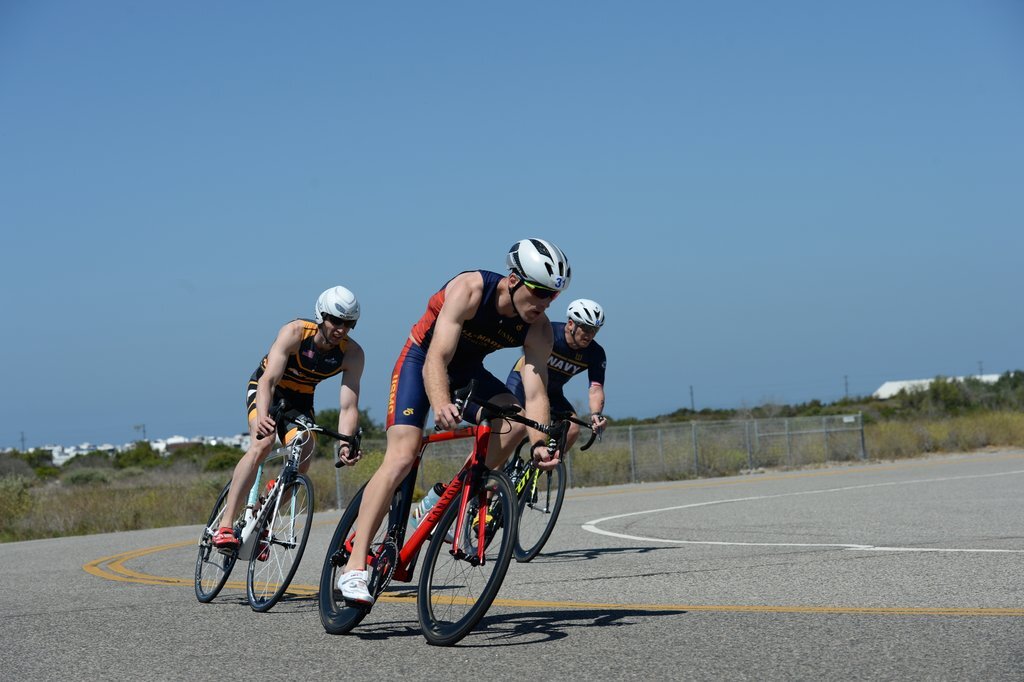
The most important training of the week for a triathlete is the “brick” event. This consists of running immediately after cycling. This should be done as close to race time as possible on the day of the week (typically Saturday).
The second most important training event of the week, contrary to popular belief, is the heavy lift day. Again, this has everything to do with hormone response. Each week, this should be completed five days prior to your brick event. Active recovery days should be taken on days of the week to support these training events, preferably the day before and after the brick to allow for optimal race day simulation performance.
Given the baseline results, we can see this is a strong athlete, which transfers well to the bike but not well to the run. The athlete’s swim, while not elite, shows a relative comfort in the water. This athlete will benefit most from learning how to run well on tired legs.
This is a basic outline of a sprint program shown to give reference points to progression. Here are the abbreviations you need to know:
RP: Race Pace
AR: Active Recovery
DL: Deadlift
FS: Front Squat
KBS: Kettlebell swing
TT: Time Trial
RFT: Rounds For Time
ME: Max Effort
| Lift (On Monday) | Muscular Endurance | Swim | Bike | Run | Brick | |
|---|---|---|---|---|---|---|
| Baseline results | DL 3151 bs. | 12 rounds | 500m in 10 min. | 10 mi. in 30 min. | 1 mi. in 10 min. | |
| Week 1 | Squat 5-4-3-2-1-1Same % as DL | 6 RFT of... 200m run, 20 knee to elbow, 20 kettlebell swings | 100m @ RP 50m @ ME | 3x10 min. TT @ ME4 min. AR spin | Mile repeat 1-1-125% rest | B30/R10 min |
| Week 2 | DL 3x3 @ 80-85% | 100 step-ups, 400m run, 75 kbs, 400m run, 50 push-ups,400m run, 25 pull-ups, 400m run | 3x250m at RP Rest 25% (4:40 work, 1:10 recover) | 8x5 min. TT @ ME 2 min. AR spin | 6x800m @ MERec. 90 sec | 35/15 |
| Lift (On Monday) | Muscular Endurance | Swim | Bike | Run | Brick | |
| Baseline results | DL 315 lbs. | 12 rounds | 500m in 10 min. | 10 mi. in 30 min. | 1 mi. in 10 min. | |
| Week 1 | Squat 5-4-3-2-1-1 Same % as DL | 6 RFT of… 200m run, 20 knee to elbow, 20 kettlebell swings | 6 rounds 100m @ RP 50m @ ME Rest 1 min | 3×10 min. TT @ ME
4 min. AR spin | Mile repeat 1-1-1 25% rest | B30/R10 min |
| Week 2 | DL 3×3 @ 80-85%
| 100 step-ups, 400m run, 75 kbs, 400m run, 50 push-ups, 400m run, 25 pull-ups, 400m run | 3x250m at RP Rest 25%
(4:40 work, 1:10 recover) | 8×5 min. TT @ ME
2 min. AR spin | 6x800m @ ME Rec. 90 sec
| 35/15
|
| Week 3 | Squat 3×3 @ 80-85% | 6 RFT 20 wall ball 400m run | 1K TT | 4x10min TT 3 min. AR spin | 10x400m @ ME Rec. 1 min. | 40/15 |
| Week 4 | DL 2-2-2-2 @ 85% | 4 RFT 800m run, 35 burpees | 250m sprint, 500m TT 100m kick | AR | 1K-800m- 400-400- 800-1K. Rec. 25% | 40/20 |
| Week 5 | Squat 2-2-2-2 @ 85% FS 3-3-3-3 @ 70% of BS | 1K run, 100 weighted step-ups, 400 flutter kicks, 1K run | 2x500m Rest 2 min.
3×50 kick Rest 20 sec. | 20 min. @ ME 10 min. AR spin 15 min. @ ME 10 min. AR | AR
| 40/25
|
| Week 6 | DL 1-1-1-1-1 @ 90% | 8 RFT 15 thrusters 200m run | 10×100 @ ME Rest :40 | 4×10 min. @ ME2 min. AR spin | Hill repeat 10×2 min. @ ME Walk down | 40/ 10-10-10 1 min. rest |
| Week 7 | Squat 1-1-1-1-1 @ 90% | Retest baseline 5-10-15 for 20 | 8×100 @ ME Rest: 30 | AR | 6x400mRec. 1 min. | 35/5×5 min. w/ 1 min. rest |
| Taper/ Race week | DL 5-4-3-2-1-1 @ 60-70-80-90-100-100+ | AR: Swim | 10x50m @ RP | 20 min. easy spin with 4-5, 1 min. RP intervals | 10x100m | RACE |
| Race Goals | 365-lb. deadlift | 16 rounds | 13 min. 750m | 35-min. 20K (12.5 mi.) | 28-min. 5K (3.1 mi.) | 1:20:00 |
This article was originally published July 22, 2018, on Coffee or Die.
Read Next: Kettle Bell Carries That Test and Build Strength and Endurance